Loyal to Love.
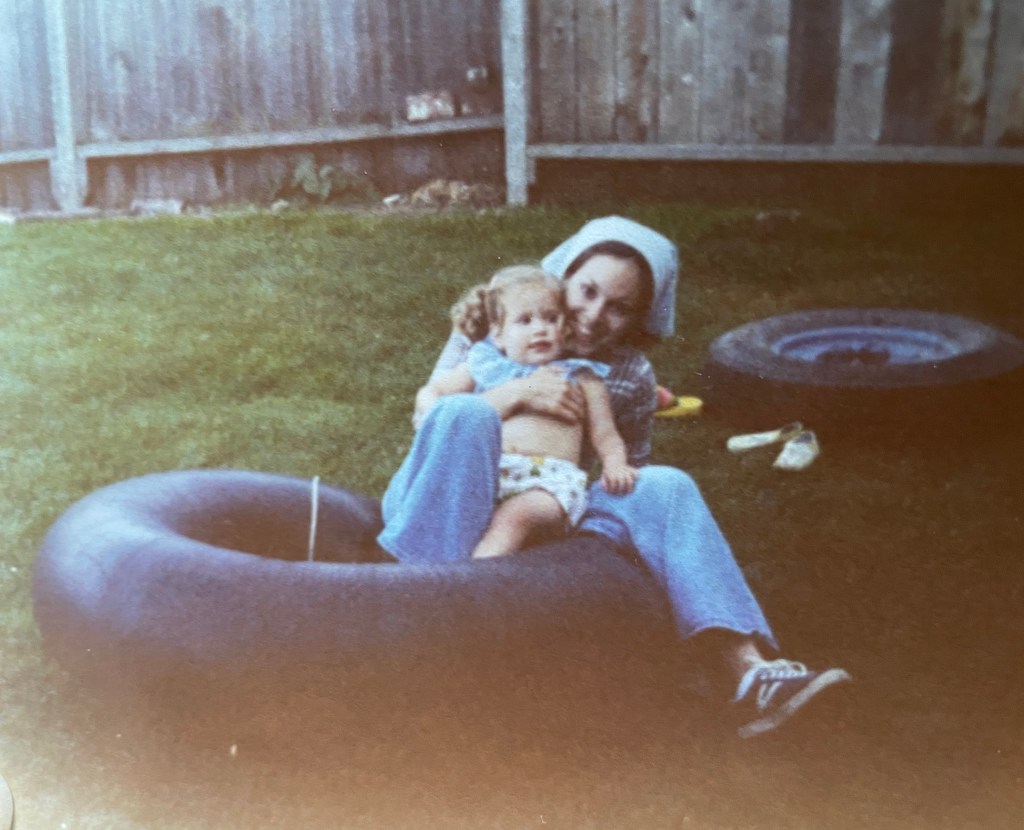
My mom was loyal to love, and her love wasn’t reserved only for her family. She could connect with anybody. At times, this quality in her could annoy me—but now I see that it was simply her essence.
She carried a childlike curiosity everywhere she went. She could bring a cashier at the grocery store to tears, or softness, or joy, simply because she saw them within that moment. If someone walked past with a cute dog, she would call out to them. She couldn’t help herself.
She was playful and goofy, too. She could say or do something that made us all laugh, without realizing she was being funny. She’d laugh along with us, even if she couldn’t quite tell what we were laughing at. She didn’t take herself too seriously; there was something so open and childlike in the way she could play.
Her curiosity extended to me, too. Even at fifty-one years old, I had apparently never aged out of my mother wanting to check my teeth. I am a fully grown woman, and she still needed me to open my mouth so she could take a look.
Phone calls with my Mom never simply began. Whether I called her or she called me, she somehow wasn’t quite ready for the call. There was never just “hello” and then a conversation. First, we had to pass through this sweet little ritual of getting Mom connected.
“Oh, oh—hold on, honey. I’ve got to put my hearing aid in. I’ve got to turn it up. I’ve got to connect it to my phone. I can’t hear you.”
She didn’t contain her curiosity or her childlikeness; she lived it everywhere. She might not remember that person’s name five years later, but in the moment, they mattered to her.
My sisters and I all inherited this from our mother. We move through the world noticing things, noticing people. And we don’t hesitate to step into someone else’s little bubble to ask a question or make an observation. We do it all the time. Even when we’re all together.
Sometimes when I’m out with my wife, she’ll notice the very same thing I do, and before I can say anything, she’ll look at me and say, “Don’t do it, Jill. Don’t do it…”
And, of course, I do it.
This was my mother’s essence. She had this beautiful way of connecting with people. It didn’t have to be deep or dramatic or lead to anything. She simply delighted in connecting with another human being.
It was almost as though she moved through life with her radar up, reminding people, in her own playful way, that we’re all human. We’re all here, sharing this strange and beautiful existence together.
What She Endured and How She Lived
What makes that brightness in my mother even more remarkable is that it did not come from an easy or painless life. She carried pain, heartache, and disappointment.
My mom fell deeply in love in her teens and married. Out of that love came three beautiful daughters. After 20 years, that love ended in heartbreak, and even after heartbreak, she continued to hope for the kind of love she was ready to give.
She wanted to be cherished. She wanted someone interested in hearing everything on her mind and in her heart, and who wanted to grow beside her— mentally, emotionally, spiritually, physically.
To me, this is what love is: cherishing one another, staying curious about each other’s inner life, and choosing to grow together.
I think real, unconditional love is something many of us spend a lifetime hoping to find—and learning how to offer.
Over time, my Mom came to understand that she needed to love herself first. That was the work she was doing near the end: learning to give herself the love she had spent so long longing for.
My mom’s life was not an easy one. She knew heartache. She knew disappointment. She had days of darkness and depression. And she wasn’t afraid to talk about those things or let me see them.
But what I find so beautiful about my mother is that she never allowed her pain to overcome her light and love. It was just a part of her human experience.
Somehow, even in the midst of her own suffering, she could still turn toward life and welcome it. She could still be curious. She could still laugh, play, and delight in another human being.
I’ve come to learn through my own journey that being fully alive isn’t about avoiding the feelings that make us uncomfortable. It’s about allowing ourselves to feel them. The grief, the anger, the heartbreak, the joy, the wonder. All of it.
And perhaps that’s what it means to be fully alive. Not to escape the painful parts of our humanity, but to make room for all of it.
She was extraordinarily good at living in the moment. She could be in pain and still notice the person in front of her. She could still delight in a dog walking by, soften a stranger, or become curious about someone’s life.
Her joy was not the absence of pain, but her willingness to remain present to it all.
What Remains of My Mother in Me
During the last two years of my mother’s life, I was in therapy doing deep work on understanding myself.
I was individuating—trying to discover who I was apart from my family without loving them any less. It was necessary, and it was also deeply painful for my mom.
During this time, I saw my mom regularly because we worked together at an Airbnb in Seattle.
Whenever she saw me, she would ask the same question, “Are you better, honey?”
Every time she asked, it hurt. I heard it as though she didn’t want to be with me in my pain, my struggle, or the difficult process of understanding myself.
But as she was passing, I began to understand her question differently- she wanted me to be free.
She wanted me to carry what I needed to carry, but not to remain trapped beneath it.
And perhaps that is what remains for me now: her invitation to be free, to love, and to live in the moment—to participate in life even when life is painful.
One of the things I’ve found myself taking joy in since my mom passed is recognizing all the little idiosyncrasies of hers that live in me.
My mom had a very particular way of keeping things. Everything she used regularly had its place. Her ChapStick belonged in a little dish on her nightstand. Her towel had its own specific spot in the bathroom. And heaven forbid somebody moved something and didn’t put it back where it belonged.
Even in the last couple of weeks of her life, when she moved to Jen and Andy’s, she still had her little systems. Everything was exactly where she needed it to be.
And I am exactly the same way.
My wife has discovered that moving my ChapStick from its designated location can be a source of considerable irritation.
So, rather than continue having this frustration in our relationship, I came up with a solution.
I bought nine chapsticks.
And I have a secret hiding place for them.
I find myself laughing at these little things now. Because they’re my mom. They’re the funny, particular, sometimes irritating little ways she moved through the world. And I recognize them in myself.
There is something deeply comforting about realizing that even though she’s no longer physically here, so much of her is still here in me. My mother’s love was mirrored back to her in the final days of being here on Earth, as her family gathered around her bedside singing songs comforting her to her final breath. She was fiercely loyal to her children, grandchildren, and great-grandchildren, who stayed by her side until her last breath.
Her essence is living in each of us.
And I’m certain in each of you because you’re here.


