When the Church Replaced Conscience with Authority
This essay reflects on church authority, spiritual harm, and what happens when questioning behavior is treated as rebellion. It’s written for those who were silenced in religious spaces for trusting their own knowing.
I spent thirty years in the church asking questions.
Not just about scripture or translation, but about behavior. About how people were treated. About the harshness. The rejection. The way people who didn’t “fall in line” were singled out, exposed, and used as lessons from the pulpit — examples of what not to do.
What I witnessed often didn’t resemble love. It resembled control.
When I raised questions — about interpretation, about contradictions, about the way people were being shamed or ostracized — I was met with the same response again and again: The leaders know God’s will more than you do. You need to trust that.
Sometimes it was said kindly. Sometimes spiritually. But the message underneath was unmistakable: Your knowing is less trustworthy than our authority.
Over time, that kind of message doesn’t just silence questions — it undermines consciousness itself. It teaches you to doubt your own perception. To override your intuition. To distrust your sense of what is humane, loving, or alive.
What I was really questioning wasn’t belief. It was behavior. It was relational ethics. It was the gap between what was preached and what was practiced.
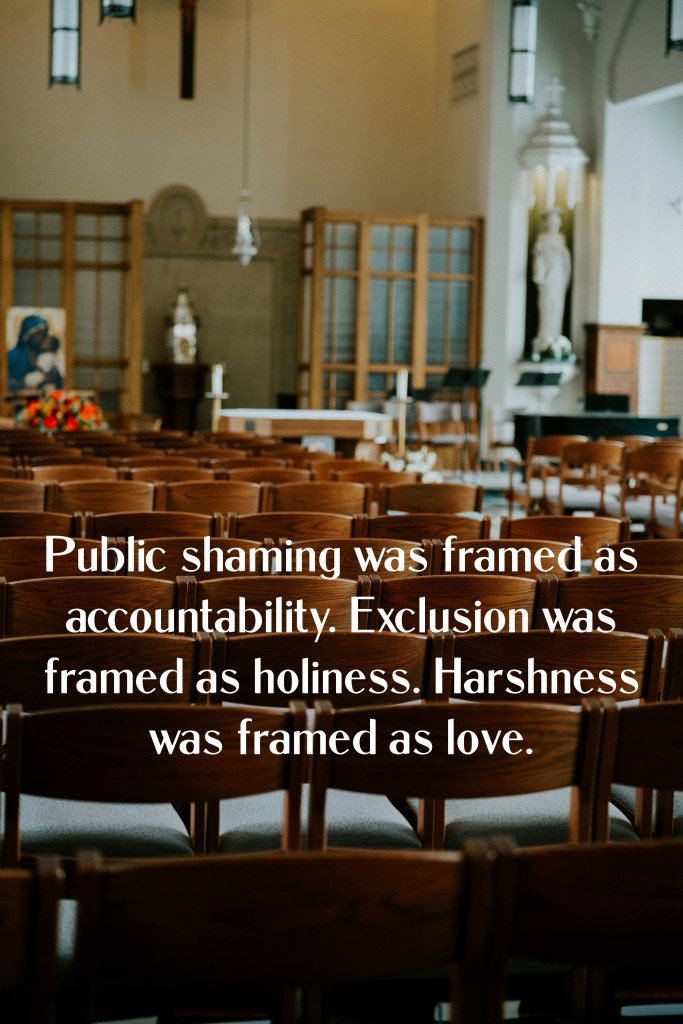
Public shaming was framed as accountability.
Exclusion was framed as holiness.
Harshness was framed as love.
And when those patterns were questioned, the response wasn’t reflection — it was reinforcement.
What strikes me now is how old this structure is. Historically, questions about religious authority have often been questions of access — who is allowed to interpret, who is allowed to speak, and whether curiosity is welcomed or constrained.
In many churches today, scripture is still filtered through a single voice at the pulpit. While this isn’t always an act of judgment, it often carries a great deal of certainty, with little room for shared reflection or conversation. Without spaces that invite curiosity, interpretation hardens into assumption, and alternative understandings quietly disappear.
When questioning behavior is treated as rebellion, something vital is lost. Aliveness shrinks. Curiosity closes. Community becomes conditional.
The most damaging part wasn’t being told I was wrong.
It was being told to stop trusting my own awareness.
My questions didn’t come from cynicism. They came from care. From conscience. From a felt sense that something was off — that love was being replaced with compliance.
I no longer measure my life by whether I believe the right things.
I measure it by whether I’m allowed to stay connected to my own knowing — my conscience, my aliveness, my capacity to name harm when I see it.
That, to me, is not rebellion.
It is honoring what is sacred and alive within me.


You are so right Honey! I see more clearly now (have been seeing clearly for awhile now)and what happened to you was happening to so many people. It was by design and purpose to keep you, us, others in control for “them” to do what they thought “their” church was suppose to be, no matter who they hurt. I always felt extremely uneasy back in those days(CCK) when you were going through everything, but didn’t know what to do, except get mad and want to yank you away and for you to never go back. I know you’re talking about CFC also, but that’s for another day and conversation🤪 I love you and I’m proud of you!
P. S. I read your post on Grandma too…..extremely precious and so well written. I have similar thoughts too. I imagine what I’d be doing with her as well if she hadn’t gone so early. Miss her so much. You have a beautiful heart Honey❤️
LikeLike