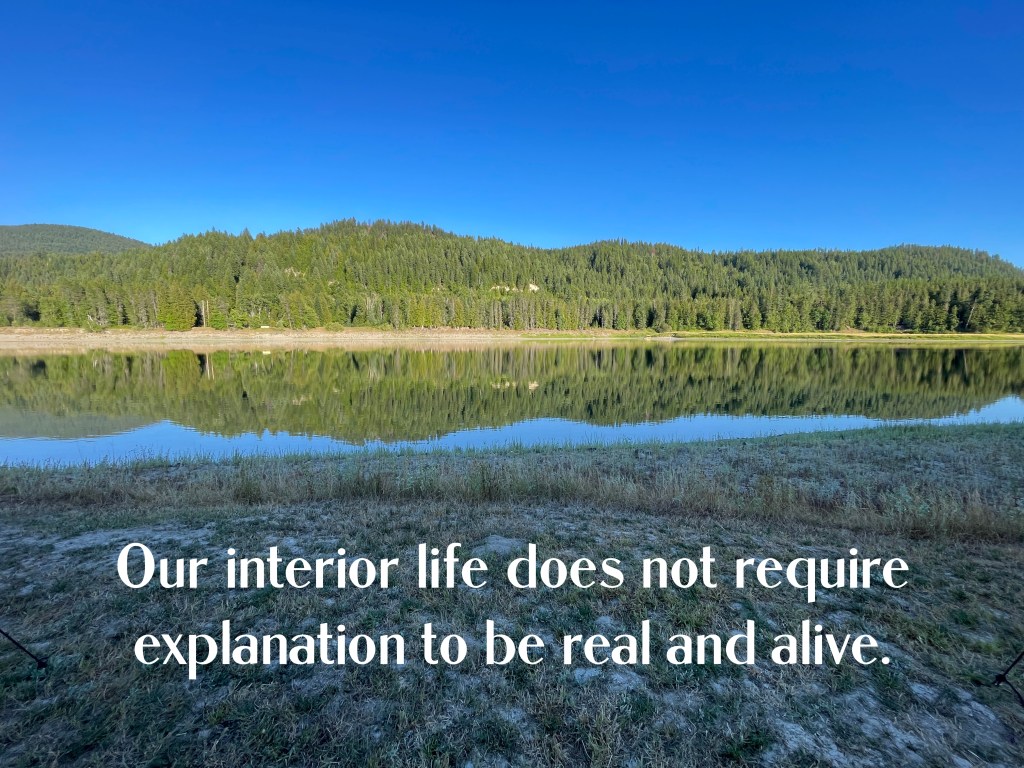
Less Certainty, More Curiousity
This is a reflection on interior life—on what unfolds beneath words, beneath certainty, and beneath what can be seen.
There is far more going on inside each of us than what our eyes can see when we look at someone.
We are taught—quietly and constantly—to assess what is visible. Tone of voice. Facial expression. Productivity. Behavior. Compliance. Confidence. We look at a person and, within seconds, make observations and judgments that feel solid and accurate. But what we are seeing is only the surface. Barely the surface.
Beneath what can be seen, named, or explained, there is an interior life that is vast, layered, and often wordless. A felt experience moving through the body that does not always translate into clean language or outward expression. And yet, it is there—shaping us, informing us, changing us.
We are not trained to trust this interior world.
We are trained to override it, to explain it away, to move past it quickly. To pull ourselves together. To keep going. To make sense—preferably out loud and preferably in ways that reassure others. We are encouraged to value clarity, articulation, and visible transformation, while quietly mistrusting what cannot yet be explained.
But not everything real is immediately speakable.
I’ve noticed this most clearly in moments when I want to express something that I feel deeply, but words arrive late—or not at all. In conversation with my wife. In friendships. Even alone with myself. There are times when I know something internally with great clarity, yet the moment I try to explain it, the language flattens it. The words feel inadequate, almost misleading. And when I push myself to speak anyway, misunderstanding often follows—not because the other person isn’t listening, but because the words were never the thing itself.
I’ve also noticed this in those liminal moments between sleeping and waking, when something feels completely clear—images, insights, understanding moving quickly and fluidly—only to disappear the moment I sit down to write. The words vanish, but the felt sense remains. The experience is still alive in me, even without its verbal counterpart.
For a long time, this frustrated me. It felt like a failure—of communication, of memory, of expression. But slowly, I’m beginning to see it differently.
The inability to fully articulate what is happening inside me does not diminish what is happening inside me.
Something can be real, active, and transformative without being visible or explainable. Interior movement does not require external evidence to justify its existence.
Part of my upbringing in the church taught me—very subtly—to mistrust this. I learned, in certain environments, that emotional experiences needed to be redirected, resolved, or translated quickly into approved meanings. Feelings were allowed, as long as they fit within an existing framework. Over time, I became skilled at setting aside what I felt in order to stay aligned, appropriate, understandable.
I don’t name this as blame. It is simply part of my lived path. A way I learned to survive and belong.
But now, as I pay closer attention to my inner life, I’m realizing how much vitality exists beneath the surface—how alive I feel when I allow my felt experience to be what it is, without rushing it into explanation. I’m learning that I don’t always need to narrate what is happening inside me. I don’t need to perform my interior life for it to be valid.
This has changed the way I look at others, too.
I wonder what might change if we trusted this more—not just in ourselves, but in one another. If we allowed for the possibility that what we see and hear is only a fraction of what is actually happening inside someone.
When we listen with our intuition as well as our ears, when we allow ourselves to feel what is being said—and what isn’t—our conversations may move in unexpected directions. Slower ones. Gentler ones. Ones shaped less by certainty and more by curiosity.
Even that small shift feels like an act of respect.
When I encounter someone —whether they seem calm or reactive, distant or confident—I hold the quiet knowing that there is far more happening inside them than I can see. That their behavior is only one expression of a much larger, unseen landscape. And that landscape deserves care, even when it remains inaccessible to me.
We alter our personalities and behaviors in response to our felt experiences all the time. Yet we rarely honor the experiences themselves. We look for outcomes, explanations, improvements. We miss the sacredness of what is unfolding internally, often without witnesses.
I am learning to trust that interior unfolding.
Whether or not I have words for it yet. Whether or not it looks like anything from the outside. Whether or not anyone else can see it.
My interior life is not incomplete because it cannot always be spoken. It is alive. And I am learning to trust what is unfinished.